Food tracking
A calorie tracker without a crowd-sourced food database
Shared food databases are full of duplicates and wrong entries. Food asks you to add a food once from the label, then logging it is a tap — and the number is right.
If you have used a mainstream calorie tracker, you know the pattern: search for "chicken breast", get four hundred results, and pick one whose numbers might be right. Multiply that uncertainty across every meal and the daily total stops meaning very much.
The databases are crowd-sourced, which is why they are enormous and why they are wrong. Nobody audits them, entries duplicate endlessly, and portion sizes are frequently invented.
Food takes the opposite approach: you add a food once, from the label in your hand, and it goes into your own library. Logging it afterwards is one tap, and the number is whatever you typed — which is to say, correct.
This sounds like more work and is, for about a week. Most people eat the same forty-odd things, so the library fills up fast and then stops growing. What you are left with is a tracker whose totals you can actually rely on.
For the same reason there is no barcode scanner and no photograph-your-plate AI. Both are guesses dressed up as measurements.
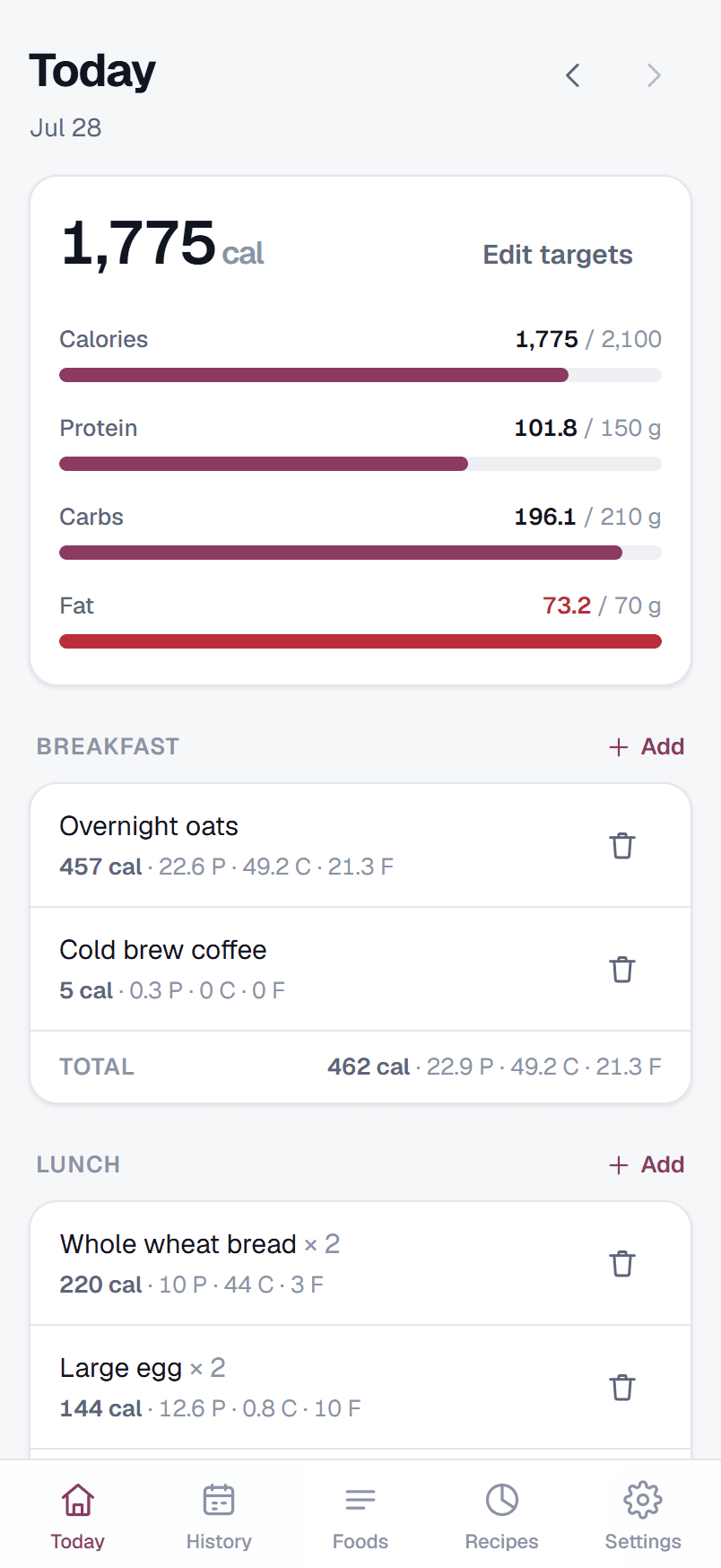
That app is Food
A calorie tracker built on the labels you read, not a database of guesses.
Free for 30 days, then $12 a year.